

Your HVAC system is a collection of interconnected components — outdoor condenser, indoor air handler or furnace, refrigerant lines, ductwork, thermostat, electrical controls, and drain systems — that all need to work together to heat and cool your home. When something goes wrong, the symptom you notice (no cooling, weak airflow, high energy bills) does not always point directly to the component that failed. Action Mechanical Services provides comprehensive HVAC repair in Peoria, taking a whole-system diagnostic approach that identifies the actual root cause, not just the most obvious suspect.
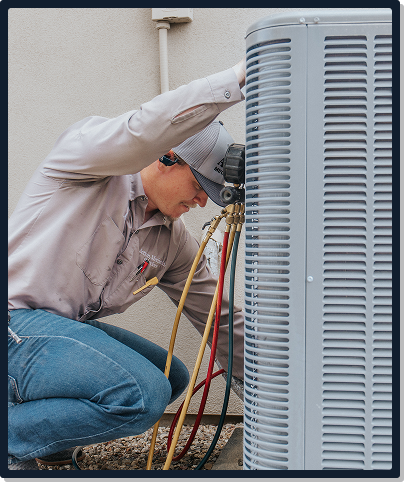
Too many HVAC repair calls end with a technician replacing the most common failure part and hoping it fixes the problem. That approach works sometimes, but it also leads to repeat visits, unnecessary parts replacements, and frustrated homeowners. Our technicians are trained to follow the diagnostic chain from symptom to source, checking each component in sequence to pinpoint exactly where the system is failing.
Whole-System HVAC Diagnostics
A proper HVAC diagnosis covers the entire system, not just the part that appears to have failed. Here is what our technicians evaluate on every HVAC repair call in Peoria:
Thermostat and Controls
The thermostat is the brain of your HVAC system, and it is the first thing we check. We verify the thermostat setting, test the wiring between the thermostat and the indoor unit, and confirm that control signals are reaching the equipment. Smart thermostats add additional diagnostic opportunities — scheduling conflicts, Wi-Fi connectivity issues, and software-driven equipment lockouts can all mimic hardware failures.
Electrical System
We measure voltage at the disconnect, test contactor operation, measure motor amp draws against rated values, test capacitors with a true capacitance meter, and check all electrical connections for tightness and corrosion. Arizona heat loosens electrical connections over time — a loose wire at a contactor terminal can cause intermittent failures that are difficult to diagnose without systematic testing.
Refrigerant Circuit
For cooling and heat pump systems, we measure superheat and subcooling to verify proper refrigerant charge and metering device operation. We check suction and liquid line pressures and temperatures, inspect the condenser and evaporator coils for restrictions, and evaluate overall system performance against manufacturer specifications. Refrigerant issues affect both heating and cooling performance in heat pump systems.
Airflow Path
We check the air filter, inspect the blower wheel for dust buildup, verify ductwork connections, and measure temperature differential across the evaporator coil. In Peoria homes, restricted airflow is one of the most common contributing factors to HVAC problems — and it is often overlooked when a technician focuses only on the component that tripped a safety switch.
Combustion (Gas Heating Systems)
For homes with gas furnaces, we test ignition sequence, measure gas pressure, inspect the heat exchanger, and analyze combustion gases for proper CO and CO2 levels. Safe combustion is non-negotiable, and every gas furnace repair includes verification that the system is operating within safe parameters.
Common HVAC Problems in Peoria
Homes in this area are often 20+ years old, which means HVAC systems may be approaching or past the end of their useful life. The challenges facing HVAC systems in Peoria are driven by the local climate:
- Capacitor failures from extreme heat — Capacitors degrade faster in Arizona’s sustained high temperatures. A failed run capacitor can stop the compressor, condenser fan, or blower motor.
- Contactor pitting and welding — High electrical loads and frequent cycling wear contactor points, eventually causing the contactor to stick closed (system runs nonstop) or fail open (system will not start).
- Coil fouling from desert dust — Dirty condenser and evaporator coils reduce heat transfer efficiency, forcing the system to work harder and increasing energy consumption.
- Condensate drain clogs — Algae and dust create blockages in condensate drain lines, triggering float switch shutdowns or water damage around the indoor unit.
- Ductwork deterioration — Flexible ductwork in Peoria attics degrades under extreme heat, developing tears, separations, and collapsed sections that waste conditioned air.
HVAC not working right? Call 480-450-7283 for diagnostic-driven repair in Peoria.